The Athlete Capability Maturity Model (ACMM)
What is it?
The Athlete Capability Maturity Model (ACMM) is a system developed to improve your management of athlete development to get full advantage from your coaching development efforts.
The ACMM is used to attract, train, deploy, and retain the athletes you need to develop a high performance competitive environment. With the help of the Capability Maturity Model Integrated (CMMI), any sport organization can make improvements in their development systems processes and practices. Many have discovered that their continued improvement requires significant changes in the way they manage all of the people involved in their organisation.
The ACMM is a maturity framework that describes the key elements of managing and developing the training groups of a sport organization. It describes an evolutionary improvement path from an ad hoc approach to managing the training groups, to a mature, disciplined development of the knowledge, skills, and motivation of the athletes, coaches and other staff that fuels enhanced performance.
What does it do?
The ACMM helps organizations to
- characterize the maturity of their athlete and coach development practices
- set priorities for improving the competence of its training groups
- integrate competence growth with process improvement
- establish a culture of performance excellence
The ACMM will support incorporating athlete management capabilities into improvement programs by communicating a model that complements the Capability Maturity Model Integrated (CMMI), and by making available an appraisal method that can be used alone or integrated with existing process appraisal methods.
The ACMM is designed to guide organizations in selecting activities for improving their development practices based on the current maturity of their development practices. By concentrating on a focused set of practices and working aggressively to install them, sport organizations can steadily improve their level of talent and make continuous and lasting gains in their performance. The ACMM guides an organization through a series of increasingly sophisticated practices and techniques for perfecting its overall development program. These practices have been chosen from experience as those that have significant impact on individual, team, and organizational performance.
How does it do this?
The Athlete Capability Maturity Model (ACMM) adapts the maturity framework of the Capability Maturity Model (CMM) [Paulk 95], for managing and developing a sport organization’s people. The motivation for the ACMM is to radically improve the ability of sport organizations to attract, develop, motivate, organize, and retain the talent needed to continuously improve athlete development capability. The ACMM is designed to allow sport organizations to integrate people improvement with sport process improvement programs guided by the CMM. The ACMM can also be used by any kind of organization as a guide for improving their people-related and work-force practices.
Based on the best current practices in the fields such as human resources and organizational development, the ACMM provides organizations with guidance on how to gain control of their processes for managing and developing their people. The ACMM helps organizations to:
- characterize the maturity of their people management practices,
- guide a program of continuous people development,
- set priorities for immediate actions,
- integrate people development with process improvement, and
- establish a culture of sport excellence.
ACMM describes an evolutionary improvement path from ad hoc, inconsistently performed practices, to a mature, disciplined development of the knowledge, skills, and motivation of the athletes and coaches, just as the CMM describes an evolutionary improvement path for the processes within an organization.
What does it look like?
The ACMM consists of five maturity levels that lay successive foundations for continuously improving talent, developing effective teams, and successfully managing the athlete and coaching assets of the organization. Each maturity level is a well-defined evolutionary plateau that institutionalizes a level of capability for developing the talent within the organization.
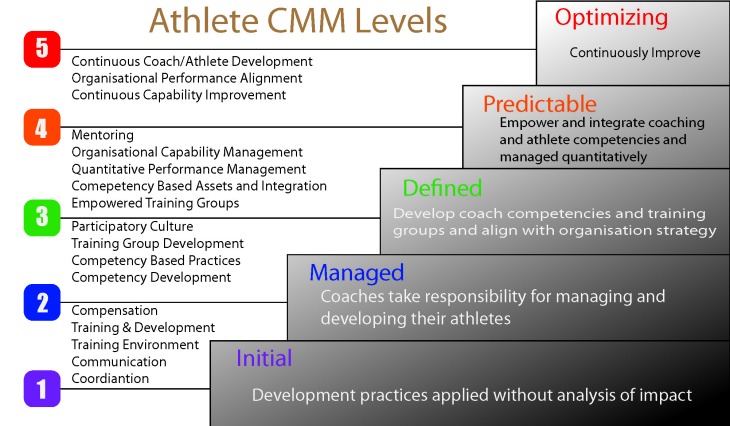
Except for Level 1, each maturity level is decomposed into several key process areas that indicate the areas an organization should focus on to improve its athlete and coaching capability. Each key process area is described in terms of the key practices that contribute to satisfying its goals. The key practices describe the infrastructure and activities that contribute most to the effective implementation and institutionalization of the key process area.
The five maturity levels of the ACMM are:
- Initial.
- Managed. The key process areas at Level 2 focus on instilling basic discipline into workforce activities. They are:
- Training Environment
- Communications
- Staffing
- Performance Management
- Education
- Compensation
- Defined. The key process areas at Level 3 address issues surrounding the identification of the organization’s primary competencies and aligning its people management activities with them. They are:
- Knowledge and Skills Analysis
- Athlete/Coach Development Planning
- Competency Development
- Career Development
- Competency-Based Practices
- Participatory Culture
- Predictable. The key process areas at Level 4 focus on quantitatively managing organizational growth in people management capabilities and in establishing competency-based teams. They are:
- Mentoring
- Team Building
- Team-Based Practices
- Organizational Competency Management
- Organizational Development
- Performance Alignment
- Optimizing. The key process areas at Level 5 cover the issues that address continuous improvement of methods for developing competency, at both the organizational and the individual level. They are:
- Personal Competency Development
- Coaching at every level
- Continuous Athlete/Coach Innovation
Find Out More
The Athlete CMM program is designed for athlete training organisations that are serious about attaining and maintaining world standards for athlete development. For more on the program and how to adopt it for your organisation contact Gerry Dragomir through a comment on this blog.
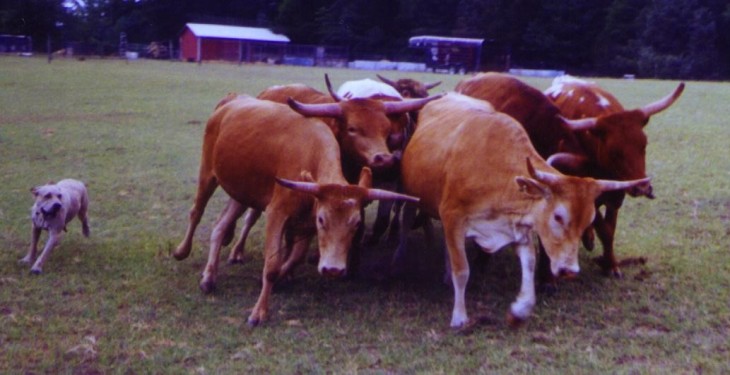 Thought leadership or innovation, as compared to science, is a very rapid process. It goes through many cycles over a short period to get the idea or innovation to a point where scientific validation is possible and necessary. Science, by its nature, is the end stage of the innovation process. Putting Science in a leading position in the innovation process primarily leads to bad science, premature validation of assumptions or validation of inappropriate assumptions.
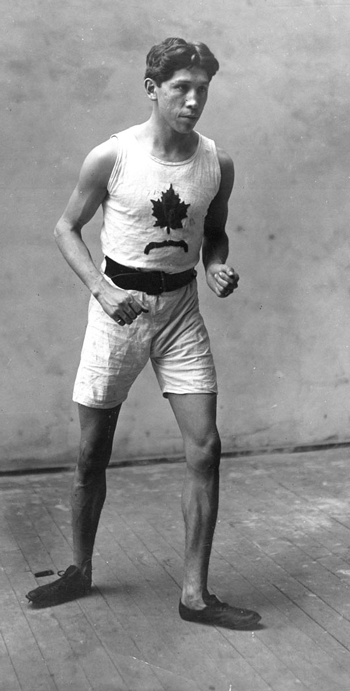 Longboat was a native Canadian and one of the most successful North American distance runners of all time. Longboat had a 13 year career that ran from 1905 to the end of the First World War. During that time, the turn of the 20th Century, the prevailing scientific knowledge dictated that lactate threshold was increased by spending maximal time at lactate threshold. The foundation for this belief was that the medical profession had just become aware of, through scientific research, the mechanisms of addiction and the phenomenon of increase in tolerance to an addictive substance. It was assumed, incorrectly, that this same mechanism worked for any substance. The ‘understanding’ was that high exposure to lactate would allow for an athlete to develop a tolerance to lactate in the same manner as addictive substances. In this case science was used to extrapolate results to capture more situations than were warranted by the context of the understanding. This is a highly common mistake that is still made way too frequently today.
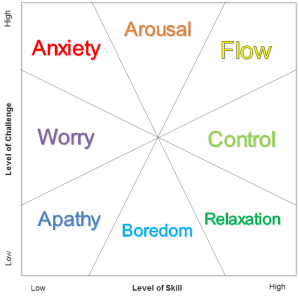 The model is a simple matrix using two axes, one for a progression of intensity (Level of Challenge) and one for a progression of capability (Level of Skill). Eight emotional states populate the interior of the matrix representing the path to the Flow State.
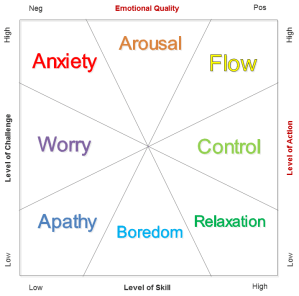 With the revised model it is now possible to see that where it is possible to generate high Quality Emotions in situations that require high Skill and offer a high degree of Challenge combined with high levels of Action a Flow State will have an increased likelihood of occurring.
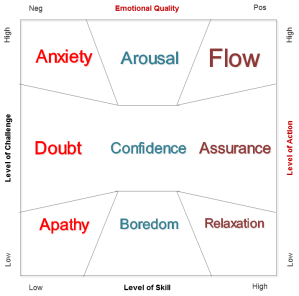 With the realisation that the second level of the matrix deals with Confidence, terms more appropriate for expression of Confidence can now be used. Worry is replaced with Doubt and Control is replaced with Assurance.
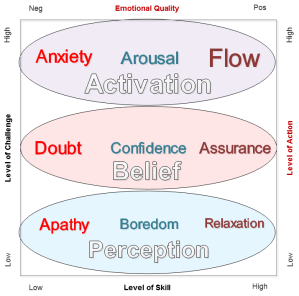 The mystery of Flow State achievement now begins to be unravelled. We see that development in the areas of Perception, Belief and Activation will lead to an improved likelihood of consistent Flow State achievement. It is highly possible to work effectively in each of the three continuums. Each of the three continuums can be worked on independently. Creating a program to address and improve function in the three continuums will improve general performance maturity which, in itself, will improve performance while making Flow States easier to achieve and more frequent in their occurrence.
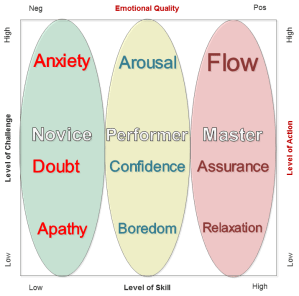 As the model now indicates the path from Novice to Master is also the path to being able to consistently establish a Flow State during performance. It is quite likely and totally consistent with the model to have a performer operating at each of the three maturity levels simultaneously. In fact, this would be considered to be the norm. A performer may have certain elements of the performance that are fully mastered where Flow State occurs consistently and naturally. The same performer will have areas where only the Performer level has been attained and Flow State is only rarely attained during those aspects of the performance. And, of course, the same performer can have areas where the Novice level exists. These areas would most likely be areas where very new technique or capability is being introduced.
 Pace Performance Enhancement